
How We Reimagined the Way Sport Is Watched
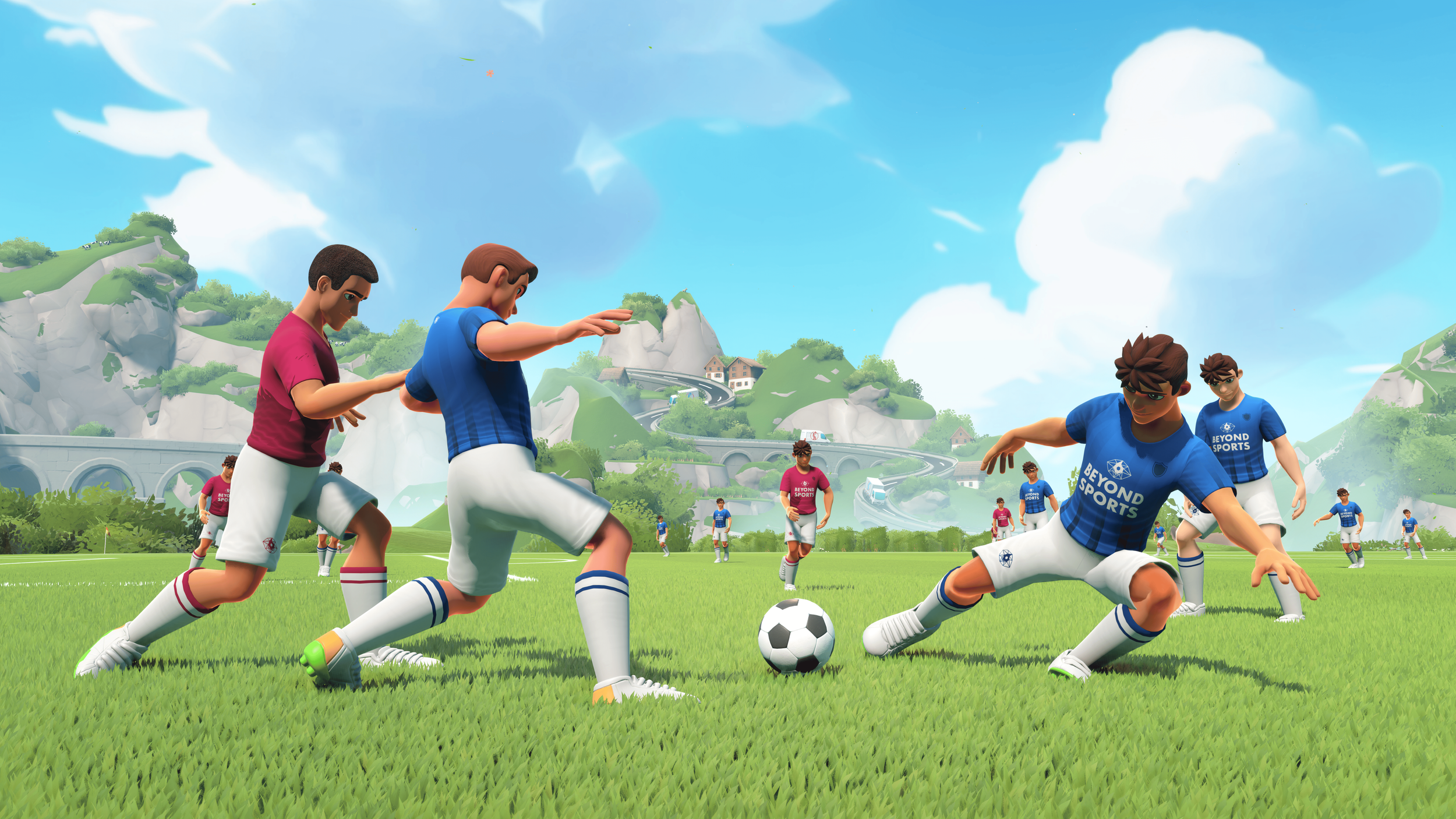
As the world becomes increasingly digital, the way audiences consume content continues to evolve. Traditional media is adapting to new platforms, new expectations, and an audience that is increasingly comfortable experiencing stories in shorter, more immediate formats.
For Beyond Sports, this raised an interesting question: how do you bring the strengths of traditional media into a more digital world without losing what made those experiences special in the first place?
In this blog, we'll take you behind the scenes of how we grew that idea, from a single virtual reality simulation built to help someone see the game differently, to full animated worlds built around beloved characters built to bring both longtime fans and a new generation of digital audiences into the game.
STUDIO ANALYSIS: A NEW WAY TO SEE THE GAME
Beyond Sports' visual evolution stemmed from one idea: give someone a new way to see and understand the game itself, not just watch it. That work started with a partnership with AZ Alkmaar over a decade ago, aimed at building a virtual reality experience that could put someone inside the action rather than in front of it, to sharpen both their training and their analysis.
The initial goal was to show a different perspective of a match, allowing viewers to watch a moment from an angle they wouldn't get with traditional sports media, to see why a certain player made a decision, like passing the ball instead of shooting at goal. That idea led to Studio Analysis, a virtual reality simulation that let viewers, athletes and coaches pick any player and view a match from their perspective, analyzing decision-making, and whether it had been the right call, because they could finally see it from a first-person angle.
It was a simple idea, but it turned out to be the one every project after it built on, and it was the same question every rights holder we spoke to had been looking to solve: what could you show a viewer that they couldn't get anywhere else.
REACHING A NEW GENERATION OF FANS
Knowing that we could change how a game was watched, the next question was who was actually watching in the first place. Our research showed that a whole generation of fans was no longer following sport via traditional formats and reaching them meant thinking beyond changing the angle to changing the world around the game itself.
One of the ideas landed upon was visual themes, a complete overhaul of the players and environment that transformed the overall look without affecting player movement. Same game, same action, different look. As an early test, we explored what this could look like using a popular children's program, recreating its location as the environment and substituting its characters for the players, for a viewing experience that would be more entertaining for kids.
Our opportunity came in 2021 via an NFC Wild Card game, our first alternative highlights cast featuring our own IP character, Blocky. It let us experiment with a more exaggerated, playful visual style, big explosions, fun effects, wacky tackle and hit animations, both to work creatively around the tackle and contact data available at the time, and to make the action more attractive to a younger audience. The NFC Wild Card Game became a great use case for pushing the visual language of the game while keeping the action recognizable and earned us two Sports Emmys – a huge milestone!
Most importantly, it showed us that familiar characters and age-appropriate formats could pull in an audience sport alone couldn't reach on its own.
STORYTELLING GOES LIVE
In 2023, ESPN’s Big City Greens Classic was the project that took it out of testing and into full length animated broadcast, putting a licensed world and a live ice hockey game in front of a real audience at the same time.
The goal was to get kids watching ice hockey through a story they already loved, woven into the live game without compromising the IP or the action itself. That meant building an environment kids would recognize as much as the game itself, a New York City, Times Square vibe layered into the Big City Greens world, with the Big City Greens family, already familiar to viewers, guiding them through it. It was the first time storytelling, not just visuals, sat at the center of one of these broadcasts.
That same environment opened up something broadcasters cared about directly: ad space within the story itself, a way to advertise inside the broadcast instead of around it, a new revenue stream neither a normal broadcast nor a normal animation could offer on its own.
The proof was already there, showing that a virtual world could carry a live game, tell its own story, and open a new line of revenue, all without diluting the sport itself, and the industry was starting to notice.
A PROVEN FORMAT
Big City Greens proved the idea could work but what came next was proving it could work again and again, across different franchises and different sports. The opportunity to work more closely with ESPN, and their access to Disney & Pixar IP, was the catalyst that turned a single success into something repeatable.
We launched Funday Football, bringing beloved franchises like Toy Story, The Simpsons, Monsters, Inc., and more into the world of sports. The Toy Story edition became, at the time, the biggest live event in Disney+ history, winning three Sports Emmys. The Monsters, Inc. edition drew an average of 563,000 viewers and contributed to one of the best weeks for ESPN's Monday Night Football in twenty years.
Alongside these, we pushed the format further introducing the Virtual Commentator: using Meta VR headsets, real commentators joined the animated world to call the action live from inside it, adding an extra dimension for viewers at home.
We also raised the visual fidelity across three areas, staying true to the IPs we used throughout.
Characters: how players, keepers and referees look, move and behave. We updated our data pipeline from a single-point system to a more complex system we call "Dynamic," combining animations and data for more realistic movement and interaction, and introduced more lifelike player heads, with greater facial detail and expression, adding personality and realism to the game.
The world around the game: side characters not directly involved in the match, walking around, having drinks, watching the game, while cars drive by and planes fly overhead, all making the world feel energetic. This included the environment itself, creating bigger worlds and larger stadiums, more interaction between characters and the elements around them, and better lighting to bring it all together.
The crowd: diverse sizes, shapes and colors, built up with lifelike movement, so people sit, stand, cheer, shout and react to the action, creating a crowd that feels genuinely alive. The key word was variation and lots of it!
That meant finding smart, efficient ways to build a world that felt as detailed and believable as the IPs themselves, within the realities of game development.
By this point it wasn't a single successful experiment anymore, it was a format, proof to any rights holder watching that this worked across leagues, across IPs, and year after year.
THE EVOLUTION OF .STUDIO
The animated broadcasts showed us something bigger than any single format: that virtual storytelling itself was the real opportunity, not just the live broadcasts built around it. That realization pushed us to build out new formats around the same idea we'd been proving out since Studio Analysis, and turned a run of successful projects into a proper offering.
Our .STUDIO offering is now the home for all of it: altcasts, virtual highlights, short-form content, virtual analysis and full-scale virtual production, produced in-house and built to work across sports, from football and American football to ice hockey, baseball and more.
What started as a way to see a match from one player's perspective has become a full production studio built to reimagine how sport gets watched, and that's the track record behind everything that comes next.
Our goal is to keep pushing the boundaries of what's possible in sports content, bringing the characters and stories people already love into the world of sport, so more fans find their way in.
Written by Farid Salah Qamaradin
